Award-winning
2019 Telstra Business Award

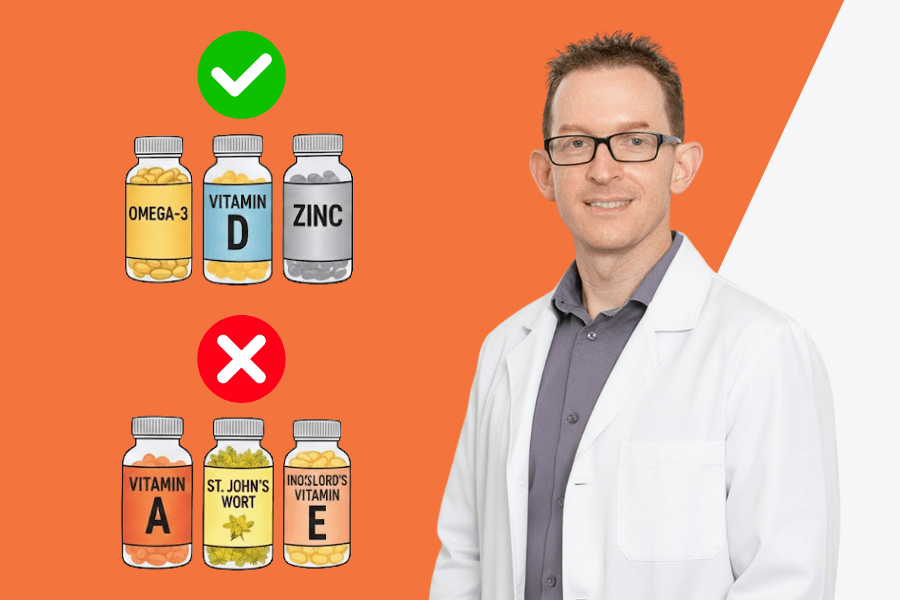
Isotretinoin (commonly known by the brand name Roaccutane) is one of the most effective acne treatments available. It dramatically reduces activity of the sebaceous glands, normalises skin cell shedding, and decreases C. acnes bacteria — but its potency also means patients often look for ways to support their skin, energy levels, and overall wellbeing during therapy.
At Dermo Direct, we are frequently asked:
As a Dermatologist – I often suggest that a lot of oral supplements are not needed whilst taking isotretinoin, as gentle skin care, emollient use and sunscreen/sun protection are the key focus areas for patients taking isotretinoin – but if patients are struggling with certain side effects, some of the following supplements can help.
Supplements are very commonly used these days, so a lot of patient are already taking supplements, and want to know if it is safe to continue them – so again this guide can help you filter out those that you should avoid whilst on isotretinoin.
Isotretinoin is a fat-soluble retinoid, and combining it with certain supplements — especially vitamin A — can increase the risk of toxicity.
Always discuss new supplements with your dermatologist, especially if you take multiple products or if they include herbal “proprietary blends”.
Why it may help:
Evidence:
Several small studies show Omega-3s improve skin hydration and reduce trans-epidermal water loss — helpful when isotretinoin dries the skin.
Recommended dose:
Standard 1,000–2,000 mg daily EPA+DHA combined (avoid very high doses unless GP-supervised).
No known interaction with isotretinoin.
Why they may help:
Isotretinoin can alter mucous membranes and occasionally flare up gut sensitivity.
Probiotics may:
Many acne patients are vitamin D deficient, particularly during winter or if they avoid sun due to photosensitivity on isotretinoin.
Benefits:
Dose:
1,000 IU daily is typical; higher doses require GP supervision.
Why it may help:
Evidence:
Zinc gluconate has mild anti-acne properties and may assist with skin repair.
Dose:
≤ 25 mg elemental zinc daily to avoid nausea or copper depletion.
High doses offer no added benefit and may cause gut upset.
This is the most important supplements to avoid.
Why:
Isotretinoin is derived from vitamin A and combining the two increases the risk of hypervitaminosis A, which can cause:
Avoid:
Most multivitamins have Vitamin A with very low levels (<1,000 IU) – this is usually safe but unnecessary.
Often found in “hair, skin & nails” formulas.
Why avoid:
Low dietary biotin is fine — avoid supplements >5,000 mcg.
Some websites claim vitamin E “protects the liver”, but high doses (>400 IU/day):
Normal dietary intake is safe.
Avoid or use caution with:
Why:
They can affect hormones, liver pathways, or interact with medications.
Avoid completely.
Why:
Often contain:
These provide no benefit and may worsen dehydration or affect liver function tests.
These supplements are commonly asked about but don’t help isotretinoin side effects:
These aren’t supplements but are extremely effective for managing dryness:
Urea-based moisturisers (5–10%)
Excellent for flaking or sensitivity.
Ceramide moisturisers
Replenish the natural skin barrier.
Nasal saline sprays
Helps with nose dryness and nosebleeds.
Lubricating eye drops
Crucial for contact lens wearers.
Lip balms with lanolin, petrolatum, ceramides
This is always needed with isotretinoin.
Disclaimer: The information in this article is for general informational purposes only and is not a substitute for professional medical advice, diagnosis, or treatment. Always seek the guidance of a qualified healthcare provider with any questions you may have about your skin or general health. Individual results may vary.