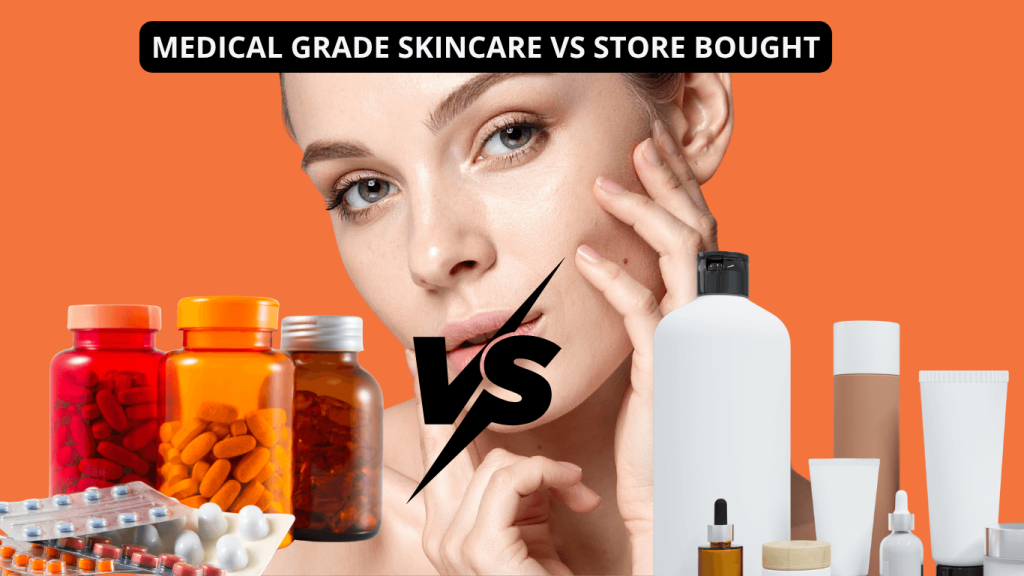
Walk into any pharmacy and the first thing that hits you is the sheer volume of it. Shelf after shelf of products, all of them promising something — clinical results, dermatologist backing, formulas that claim significant benefits. And somewhere between the $12 moisturiser and the $89 serum sitting literally right beside it, a pretty reasonable question starts forming. What exactly am I paying for here? That’s the question at the centre of the medical grade skincare vs store bought conversation, and the information is not always presented clearly.
So let’s actually try.
The ingredient story — And why it’s not as simple as reading a label
Here’s what most people do when they’re comparing two skincare products. They flip to the back, run their eyes down the ingredient list, spot the same hero ingredient in both, and land on what feels like a logical conclusion — same stuff, different packaging, different price. Why pay more?
Sometimes that logic holds. Quite often, it doesn’t. In some cases, it does not.
The ingredient name on the label is only part of the story. What it doesn’t tell you is how much of that ingredient is actually in the formula, how well it’s been stabilised, or how far into the skin it’s been designed to travel. Store bought skincare — whether you grab it from a supermarket, a pharmacy, or an online order — operates within cosmetic regulations. That’s not a criticism, it’s just the category it sits in. The medical grade skincare vs. over-the-counter distinction isn’t just about where you buy it, though. In Australia, many over-the-counter products are designed to act primarily on the surface layers of the skin. They can hydrate, smooth, and temporarily improve how skin looks and feels. That’s not nothing — which may limit their effect for certain conditions.
Medical grade formulations are designed for different clinical purposes. The actives — retinoids, high-concentration vitamin C, pharmaceutical grade niacinamide, prescription-strength exfoliants — may be formulated at concentrations intended to have a greater biological effect. They’re designed to influence skin processes at a deeper level, depending on the formulation, which differs from cosmetic formulations in some cases.
Two products. Same ingredient name on the label. Potentially different outcomes. That’s not unusual in this space — it’s actually not uncommon.
Let’s talk about retinol, because everyone always does
Retinol is probably the most discussed skincare ingredient of the last two decades, and it’s a good illustration of the concentration gap.
A typical store bought retinol product sits somewhere between 0.01% and 0.1%. Some of the bolder over-the-counter options push toward 0.3%, which are typically higher in cost. Medical grade retinoids are a different story — and in some cases, they skip the retinol conversion process entirely, working with tretinoin directly. This is relevant because retinol has to convert inside the skin before it becomes active. Tretinoin does not require conversion. The skin gets the active form, not a precursor to it.
Vitamin C tells a similar story. Pharmacy vitamin C serums often sit between 5 and 15% L-ascorbic acid — but concentration alone doesn’t tell you everything. Vitamin C is notoriously unstable. If the formulation isn’t engineered to keep it stable and deliver it where it needs to go, a lot of that active oxidises before it provides intended effects. Medical grade vitamin C formulations tend to address this more rigorously. It’s not just about percentage —it’s about what actually reaches the skin.
None of this is to say store bought products are a waste of money. Plenty of them are genuinely good. But “same ingredient, cheaper price” is a simplification that doesn’t always hold up when you look at what’s behind the label.
Is medical grade skincare actually worth the price?
Here’s where the honest answer gets a little uncomfortable.
In some cases, it may not be necessary If your skin is behaving itself — balanced, reasonably clear, with no significant concerns — a well-chosen drugstore routine can do the job. Cleanser, SPF, a decent moisturiser. These basics don’t require a prescription to be effective.
But for skin dealing with persistent acne, eczema, deep hyperpigmentation, significant sun damage, or scarring — the gap between what a cosmetic product is permitted to do and what a clinical formulation is designed to do becomes more clinically relevant. These are conditions that sit at the clinical end of skincare. And cosmetic products, however good, may not be sufficient for clinical-level concerns.
That’s not a value judgement. It’s a category distinction. Different approaches are suited to different types of skin concerns. You just have to know which problem you’re dealing with.
What Australian regulations actually mean for your routine
In Australia, the TGA distinguishes between cosmetic products and therapeutic products. Cosmetic products are designed to act on the skin’s surface — they cannot legally claim to treat or prevent a condition. Therapeutic products that make those claims are regulated to a higher standard, with stricter requirements around clinical evidence and safety.
So when you see a pharmacy product promising to “visibly reduce” something, that language is deliberate. Visibly reduce is cosmetic territory. Treat is therapeutic territory, and that requires a different level of evidence to back it up.
Some products referred to as “medical grade” may fall under therapeutic regulation depending on their ingredients and claims. The formulations may be developed with clinical input and evaluated for safety and efficacy, tested against clinical benchmarks, and prescribed or recommended within a professional framework. That overhead is part of why they cost more — but it’s also part of why they may provide effects beyond those typically seen with cosmetic formulations.
Acne, specifically — because this is where it gets personal
For anyone whose acne has moved past the occasional hormonal breakout into something more persistent, the store bought vs medical grade question stops being abstract pretty quickly.
Over-the-counter salicylic acid, benzoyl peroxide, and sulphur-based products are genuinely useful for mild, surface-level breakouts. For moderate to severe acne — the kind that lingers, scars, or cycles back every few weeks regardless of what you try — they may have limited effectiveness in some cases.
Medical grade acne treatment may involve different treatment approaches. Higher concentration actives. Prescription retinoids. Sometimes compounded formulations put together specifically for an individual’s skin profile and how it’s behaving. And critically, professional oversight. Someone who can actually look at what your skin is doing and adjust the approach accordingly.
That last part is something a pharmacy shelf fundamentally can’t offer, no matter how good the product is. Dermo Direct’s approach is built around exactly this —matching clinical formulations to individual skin concerns rather than defaulting to a broad, generalised protocol. Individualised assessment may be important. Treatment should be tailored to individual needs.
Why can’t you just buy medical grade skincare off the shelf?
Potent actives — tretinoin, hydroquinone, high-strength acids — can cause real problems when used incorrectly. Irritation, photosensitivity, barrier damage, and in some cases, worsening of the very condition you’re trying to treat. The access restrictions exist because these products work precisely because they’re strong. Strong without guidance is where skin damage often starts.
The good news is that accessing medical grade skincare in Australia has become more accessible for some patients. Telehealth consultations with AHPRA-registered practitioners of teledermatology services like Dermo Direct mean you consultations can be conducted remotely. A clinical assessment, a tailored protocol, and ongoing oversight —all of it is now available without leaving home.
Store bought skincare isn’t the villain here
This is worth saying plainly, because the tone of these comparisons can start to feel like an attack on drugstore products. It isn’t.
Most people run a mixed routine, and that makes complete sense. A gentle pharmacy cleanser can sit perfectly alongside a medical grade retinoid. A well-formulated store bought SPF — and there are well-formulated options — is still one of the most important things you put on your skin. The goal isn’t to replace everything. It’s to understand what each product category is actually capable of, and make choices based on that.
The mistake is assuming that because something is labelled as treating the same concern, it’s doing the same thing at the same depth. This assumption may lead to ineffective product selection.
Where does this leave you?
If your current routine is working — skin clear, comfortable, no persistent concerns — changes may not be necessary. Consistent basics are often more effective than inconsistent routines.
But if you’ve been thorough, been patient, and your skin still isn’t responding, the issue may relate to product suitability. It might be the category of product you’ve been working with.
Medical grade skincare vs store bought isn’t a competition with a winner. It’s a question of fit — matching the right tool to what your skin actually needs. For skin concerns that have crossed into clinical territory, professional guidance and clinical-grade formulations aren’t a luxury upgrade. They may be an appropriate option in some cases