Award-winning
2019 Telstra Business Award

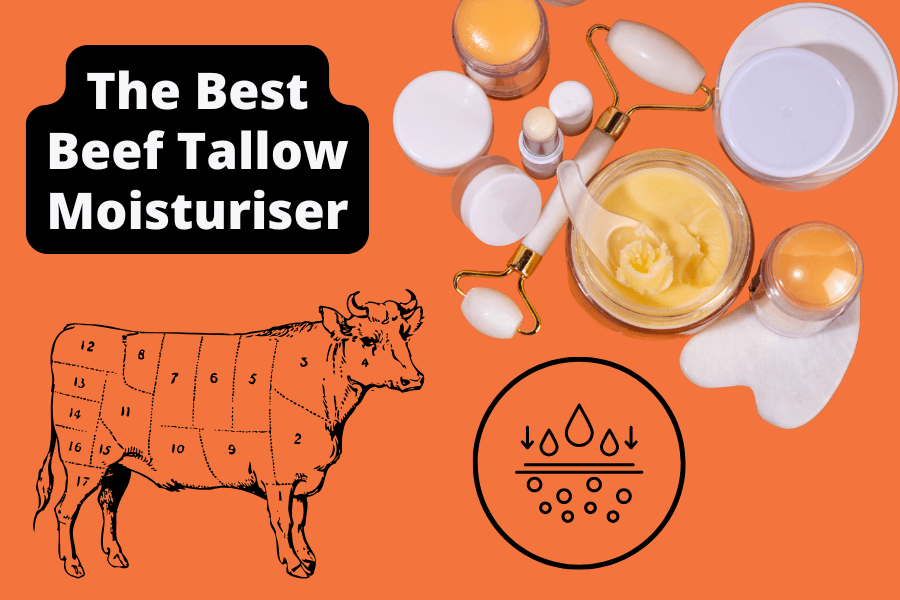
Beef tallow moisturiser. Two words that would have cleared a room at a beauty event five years ago.
And yet here we are. People are quietly putting rendered cattle fat on their faces — and a lot of them are reporting that their skin has never felt better. Not after the thirty-dollar serums. Not after the dermatologist-recommended cream that cost even more. After tallow.
It sounds strange. It smells faintly like a Sunday roast when it’s warming in your hands. And it absolutely flies in the face of everything the modern skincare industry has been telling us for decades.
But maybe that’s part of the point.
There’s something that almost never comes up in skincare conversations, and it probably should.
Your skin makes fat. That’s part of its job. It produces something called sebum — a natural oil that keeps the surface protected, pliable, and functional. And when you break sebum down, what you find inside it are fatty acids. Oleic acid. Palmitic acid. Stearic acid. A few others.
Now look at what’s in beef tallow.
Many of the same fatty acids found in sebum — including oleic, palmitic and stearic acid — are also present in beef tallow, in ratios that overlap with those naturally found in skin lipids.
That’s not a coincidence. And for a lot of people, it explains something they couldn’t quite put their finger on — why tallow doesn’t feel like most moisturisers. It doesn’t sit on the surface doing nothing. It doesn’t leave that slightly waxy film that some creams leave behind. It absorbs in a way that feels less like you’ve applied a product. Many people find it softens and spreads easily once warmed between the fingers and more like your skin has just… settled.
Then there’s the vitamin side of things. Quality tallow — particularly from well-raised, grass-fed cattle — naturally contains vitamins A, D, E, and K. Not because anyone added them. Because they were already there in the fat of a healthy animal. Tallow naturally contains fat-soluble vitamins such as A, D, E and K in small amounts, extracted and reformulated and sold at a premium.
In tallow, they come as part of the package.
People used this for centuries before petroleum jelly existed. Before synthetic emulsifiers became the default. Before the skincare aisle looked the way it does today. It was widely used as a traditional skin protectant — on cracked hands, on wind-burned faces, on skin that took a beating and needed something real to recover.
Whether swapping all of that out for modern formulations was genuinely progress — or just progress-adjacent — is a question a lot of people are quietly starting to revisit.
Yes. And not just as a marketing line.
The quality of tallow is directly tied to the health and diet of the animal it comes from. Cattle that spend their lives grazing on open pasture — as is the case with much of Australia’s livestock in regional areas — produce fat with a different nutritional profile compared to grain-fed, feedlot animals.
Diet and farming practices may influence the fatty acid profile of animal fats.
Australian grass-fed tallow balm made from cattle raised in regions associated with regenerative farming NSW and QLD has developed a real following for exactly this reason. These aren’t factory operations. Many of them rotate cattle across paddocks, let pasture recover naturally, and treat land management as part of what they do — not an afterthought.
When you’re trying to buy beef tallow skincare AU, it’s worth asking the brand directly. Where does the tallow come from? Can they speak to how the cattle were raised? A brand that takes sourcing seriously will have answers. One that doesn’t — well, that tells you something too.
Here’s what a lot of people with sensitive or chronically dry skin eventually figure out — usually after years of trial and error.
It’s not always the main active ingredient causing the problem. It’s everything else in the bottle.
Fragrances. Preservatives. Emulsifiers that keep the product stable on the shelf but don’t always agree with skin that’s already compromised. You switch products, your skin calms down briefly, then something new shows up. It becomes a guessing game.
That’s why the appeal of a minimal-ingredient moisturiser isn’t really about being anti-science or following a trend. For a lot of people, it’s just a process of elimination. Fewer ingredients means fewer things to react to. It’s that simple.
Organic tallow face cream tends to have a very short ingredient list. Sometimes it’s just tallow and a carrier oil. That’s it. No emulsifiers because tallow doesn’t need them. Some formulations rely on tallow’s stability as a saturated fat rather than added preservatives. No fragrance unless someone’s deliberately added it.
Tallow functions as an occlusive, meaning it forms a layer that helps reduce transepidermal water loss. It slows water loss from the skin surface — which is exactly what very dry or barrier-compromised skin needs. Not more water poured onto it. A way to keep the water it already has.
You don’t need a complicated routine for this.
Cleanse. Pat your skin mostly dry — not bone dry, leave a little moisture on the surface. Then warm a tiny amount of tallow between your fingertips and press it gently into your skin. It softens fast with body heat. Start with less than you think you need.
Do it morning and night. Consistently. Give it three or four weeks before you make any judgements — skin doesn’t turn around overnight, and tallow is not that kind of ingredient. Skin comfort and texture changes, where they occur, tend to develop gradually., and the people who stick with it tend to notice changes in texture and comfort over time rather than immediately.
One thing worth knowing if you’re already using a vitamin A product — tallow fits naturally into what’s called the retinol sandwich method. The idea is straightforward. You apply a layer of moisturiser before your retinoid, let it absorb, apply the retinoid, then seal with moisturiser again. The cushioning effect on either side can reduce the dryness and peeling that often comes with early retinol use.
Although tallow contains small amounts of naturally occurring vitamin A, it does not function as a prescription-strength retinoid alongside its fatty acid base, it works well in this kind of layering approach. That said — if you’re using a prescription retinoid, check with your dermatologist before changing anything about how you apply it.
The market for tallow moisturiser Australia-wide is still relatively niche, which means there’s real variation in quality. A few practical things to look for:
Sourcing transparency. A good brand will tell you where their tallow comes from and how the animals were raised. Grass-fed, pasture-raised Australian cattle — ideally from regenerative farming operations — is what you’re looking for. If a brand is vague about this, that’s useful information.
Ingredient list length. Short is better. If you’re buying tallow for its simplicity, a product with fifteen ingredients is missing the point.
No synthetic fragrance. Even products that describe themselves as natural can contain fragrance blends. If your skin is sensitive, check for this specifically.
Responsible claims. Under Australian law and TGA guidelines, cosmetic products cannot claim to treat, cure, or prevent skin conditions. Any tallow product making those kinds of promises isn’t just bending the rules — it’s being dishonest about what it can do. Stick to brands that describe what the product contains rather than promising medical outcomes.
Ancestral skincare Australia conversations sometimes present tallow as a universal solution. It isn’t.
Dry and sensitive skin types tend to respond well to it. Oily and acne-prone skin — harder to predict. Some people find it too heavy. Others use it without issue. If you’re in that camp, try it on a small area first and give your skin a week before drawing any conclusions.
If you have a diagnosed skin condition — rosacea, eczema, psoriasis — please speak to a dermatologist before adding anything new to your routine. Tallow is a cosmetic ingredient. It’s not a treatment, and it shouldn’t be positioned as one.
Everything here is for general educational purposes only. Beef tallow moisturiser is a cosmetic product — it is not presented anywhere on Dermo Direct as a treatment for any skin condition. If you have concerns about your skin or are managing a diagnosed condition, a conversation with a registered dermatologist is always the right first step. All content on this site is produced in compliance with AHPRA and TGA guidelines.
Tallow isn’t new. That’s the thing people forget.
It didn’t get discovered by a skincare brand or validated by an influencer. It’s been around longer than the entire cosmetics industry — used by people who didn’t have thirty options on a shelf and somehow still managed to keep their skin in decent shape through harsh winters, dry climates, and a lifetime of outdoor work.
Somewhere along the way, we decided that older meant inferior. That newer formulations with longer ingredient lists were automatically better. And for a lot of people — especially those with dry or sensitive skin — that assumption has cost them years of frustration and a fair amount of money.
The current interest in tallow isn’t really a trend. Trends come and go quickly. This feels more like people slowly arriving at the same conclusion from different directions. They stripped back their routines. They got suspicious of ingredient lists they couldn’t read. They started asking what actually worked — not what was well-marketed.
And a meaningful number of them landed on this.
If your skin has been dry, tight, reactive, or just quietly miserable for a while, and you haven’t tried a quality beef tallow moisturiser from Australian grass-fed cattle — it may be one option to consider alongside other moisturising products. Patch test first. Commit to a few weeks. Don’t judge it after two days.
Your skin has a way of letting you know when something actually agrees with it.
Disclaimer: This article is for general informational purposes only and does not constitute medical advice. Always consult a qualified dermatologist or healthcare professional for personalised skin health guidance. All claims are cosmetic in nature and comply with AHPRA and TGA guidelines.